





















Integrated Threat Intelligence for Buildings: What It Is and How It Works
Most security teams find out about a threat once it’s already happened. A protest blocks the street outside. A break-in two doors down makes the local news the next morning. By the time the information reaches the building, it’s history, not intelligence.
Integrated threat intelligence flips that. It brings verified, real-time risk data directly into the way a building is monitored and managed, so teams know about a threat before it reaches the door rather than after. This article covers what that actually means, why it matters specifically for buildings, and how it works in day-to-day operations.
For more information on Threat Intelligence, read our Guide to Threat Intelligence
What Integrated Threat Intelligence Actually Means
At its core, threat intelligence is verified information about risks that could affect a specific site: crime, terrorism, protest activity, and environmental hazards among them. “Integrated” is the part that matters most for buildings. Rather than sitting in a separate feed or a general news alert, the intelligence is tied directly into the building’s own security operations, so it reaches the right people at the right time, alongside everything else they’re already managing.
This is a meaningful shift from how most buildings historically handled external risk. A security manager might have subscribed to a general news alert service, followed local police social media, or relied on tenants forwarding on anything they’d heard. None of that is verified, none of it is filtered to the building’s exact footprint, and none of it connects to how the team actually works day to day.

From Generic Alerts to Integrated Intelligence
General alert services and news feeds cover huge geographic areas and rarely distinguish between something genuinely relevant and something happening several miles away with no bearing on the building at all. Over time, teams either drown in noise or stop paying attention altogether. Integrated threat intelligence developed specifically to solve that problem, narrowing the scope to what’s verified, relevant, and close enough to matter, then feeding it into the tools a team already uses rather than adding another one.
How Verification Actually Works
The word “verified” does a lot of work in this space, and it’s worth explaining rather than taking on faith. Raw information about a potential threat, a social media post, a rumour, an unconfirmed police scanner mention, isn’t intelligence yet. It becomes useful only once it’s been checked against other sources, assessed for credibility, and confirmed as accurate. This is the step that separates a genuine early warning system from a stream of speculation that happens to be right occasionally.
In practice, this means cross-referencing multiple sources before an alert is pushed out, checking timing and location details for consistency, and filtering out anything that can’t be substantiated. A building relying on unverified sources isn’t getting ahead of risk, it’s just getting more noise earlier. Speed only has value once accuracy is in place, not instead of it.
Why Buildings Need This Specifically
A single building can face a wide range of risks depending on location, tenants, and footfall. An office tower in a city centre has different exposure to a retail unit on a high street or a logistics site on the edge of town. Generic, one-size-fits-all threat feeds tend to bury the relevant alert under dozens of irrelevant ones. Integrated threat intelligence filters for what’s actually relevant to that site, so teams aren’t left sorting signal from noise during a live situation.
Multi-tenant commercial buildings face a particular version of this challenge. A single site might house a law firm, a retailer, and a co-working space, each with different risk tolerances and different expectations of the building’s security team. A protest three streets away might be irrelevant to one tenant and directly disruptive to another, depending on their business and their footfall. Threat intelligence that’s genuinely integrated into building operations can be shared appropriately across tenants without every business having to run its own separate monitoring.
The Threat Types, Explained
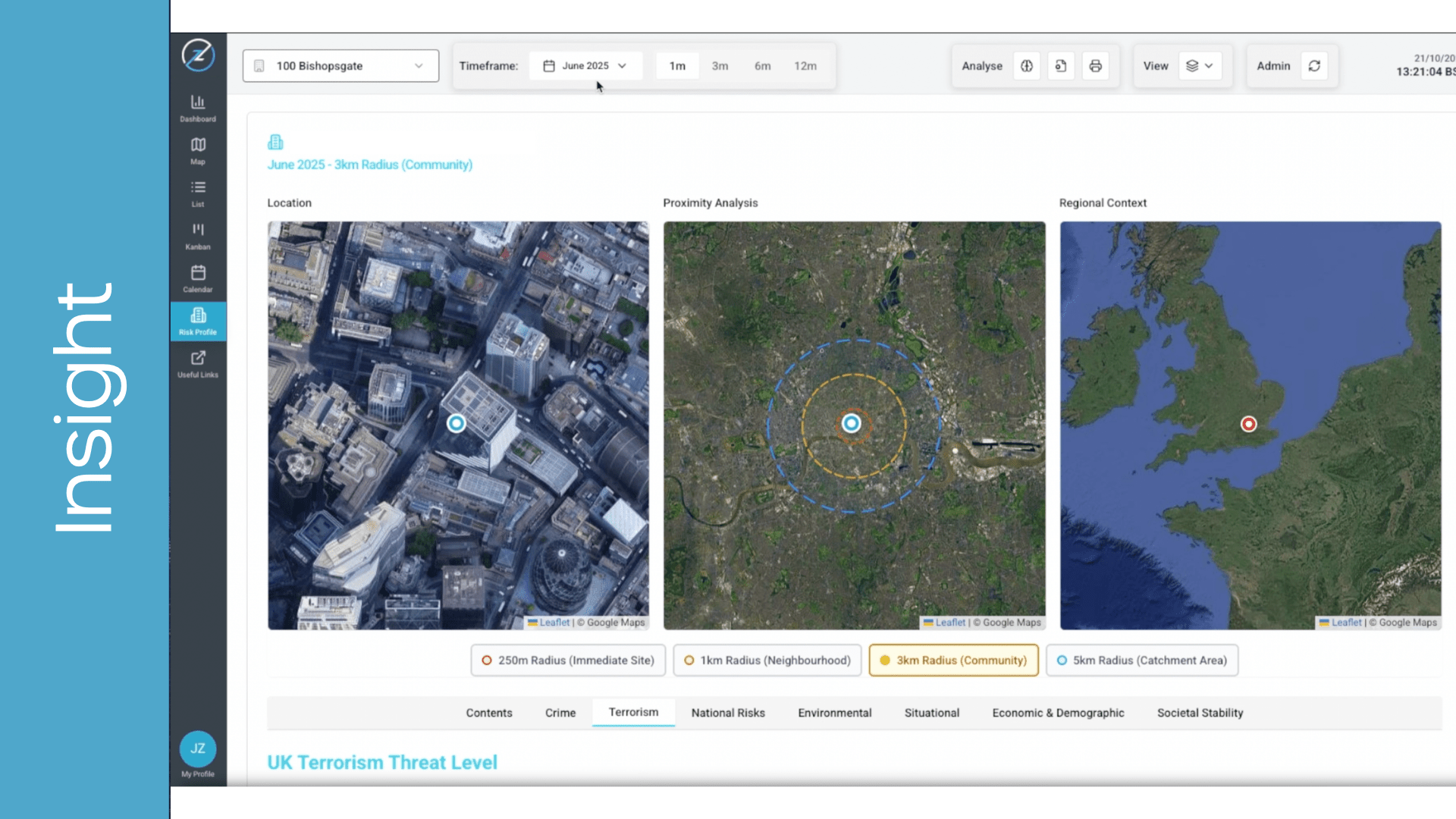
These are the threat types pulled through on Zinc’s live intel feed: verified alerts checked and pushed directly to a building’s team in real time.
Crime. Verified reports of nearby criminal activity, from break-ins to street crime, that could indicate a rising risk to a specific site or its surrounding area.
Terrorism. Verified alerts related to terrorism threats or activity, including official notices that affect a specific radius around a location.
Protest activity. Planned or ongoing demonstrations that could affect access, footfall, or safety around a building, particularly relevant for city-centre and high-profile sites.
Environmental risk. Severe weather, flooding, and similar hazards that could affect a building’s operations or the safety of people on site.
Alongside the live feed, the location risk profile tab covers four further risk types: internal, situational, societal, and economic, giving teams a fuller picture of exposure beyond real-time alerts alone. None of these categories are useful in isolation if they arrive too late, too broadly, or without verification. The value comes from combining accuracy, relevance, and speed, and putting all four risk types through the same filtered, integrated pipeline rather than treating each as a separate concern.
How It Works in Practice
Verified data sources: Alerts are pulled from monitored sources covering crime, terrorism, protest activity, and environmental risk, then checked before they reach a building’s team. Unverified chatter doesn’t make the cut.
Site-specific filtering: Every alert is filtered against the building’s exact location and radius. A threat two miles away that poses no real risk doesn’t need to interrupt anyone’s day. A threat two streets away does.
Direct integration with daily operations: Rather than living in a separate dashboard, the intelligence feeds into the same system the security team already uses to manage patrols, incidents, and shift handover. An alert becomes part of the operational picture, not an extra thing to check.
Prioritisation: Not every alert carries the same weight. Well-built systems rank threats by severity and proximity, so the team’s attention goes to what matters most first.

How This Plays Out on Site
A verified alert comes in flagging planned protest activity two streets from the building, scheduled for the following week. Because the system filters by radius, the alert reaches the building’s control room directly rather than getting lost in a general news bulletin covering the whole city.
The security manager reviews the alert alongside the day’s existing patrol schedule and incident log, all in the same system. With over a week’s notice, patrol routes can be planned in advance to keep a closer eye on entrances most likely to be affected, and tenants are briefed well ahead of time so nobody is caught off guard. If the protest does affect footfall or access on the day, that context is already logged and ready to reference, rather than having to be explained after the fact.
None of this required a separate app, a manual news search, or a phone call to ask if anyone had heard anything. The information arrived filtered, verified, and already sitting alongside the tools the team uses for everything else.
What Threat Intelligence Doesn’t Do
It’s worth being honest about the limits of this too. Threat intelligence doesn’t replace physical security measures, trained personnel, or good judgement on site. It doesn’t predict every incident, and no verified feed will ever cover every possible risk with perfect accuracy. What it does is remove a specific, avoidable failure: a building being caught off guard by something that was already known and could have been checked in advance. It closes the gap between information existing somewhere and information reaching the people who need it, in time to act.
There’s also a risk of over-reliance if it’s treated as a replacement for a team’s own awareness rather than a support for it. The strongest security operations use verified intelligence to sharpen decisions that trained staff are already making, not as a substitute for having trained staff in the first place.
What This Changes for a Security Team
The practical shift is from reactive to proactive. Instead of reacting to an incident once it’s on the doorstep, teams get advance notice, enough to review access points, brief staff, or adjust patrol patterns before anything happens on site.
Over time, this also builds a clearer picture of the risk landscape around a building. A single alert is useful in the moment. A record of alerts over months reveals patterns, whether that’s a particular time of year when protest activity rises nearby, or a location that sees a recurring type of crime. That pattern feeds into longer-term planning, staffing decisions, and conversations with tenants, in a way a one-off alert never could on its own.
The Bigger Picture
Threat intelligence only earns its name when it’s specific, verified, and integrated into how a building actually runs day to day. A feed nobody looks at isn’t intelligence, it’s noise. Built properly, it becomes one more input the security team can trust, sitting alongside patrols, incident logs, and case records rather than apart from them.
For buildings managing multiple tenants, tight footfall, or high public visibility, that advance notice is often the difference between a calm, planned response and a scramble. Getting ahead of a risk, even by a few hours, changes what a security team is able to do about it.
Zinc’s Threat Intelligence module brings verified alerts on crime, terrorism, protest activity, and environmental risk directly into your existing security operations, filtered to your specific sites.




 +44 (0)20 3989 4859
 info@zinc.systems

